

12·
9 months agoDepending on your computers specs & if it’s allowed or not by your company… You could always continue to use Fedora & run win-11 inside a VM with pass through enabled…

Sometimes…
Depending on your computers specs & if it’s allowed or not by your company… You could always continue to use Fedora & run win-11 inside a VM with pass through enabled…
Personally for me Arch on my system has been more stable & faster than both Debian & Fedora…
M$ loves locking users into their totally bulls*it ecosystem with deliberately broken “standards.” LibreOffice, on the other hand, actually respects open formats like ODF and doesn’t treat interoperability as a threat. Word still can’t properly open documents it didn’t create, unless you pay the vendor tax and pray the formatting survives…
If a program insists on Windows, it is instantly deemed incompatible with my operating parameters and fails my system requirements…
When I switched from Windows to Linux back in 2002, I never looked back. I missed absolutely nothing. Linux offered everything I needed and more, with unmatched freedom and flexibility. In late 2008, I bought a unibody MacBook, and while macOS wasn’t bad per se, it just didn’t feel like home. I missed Linux too much, so I wiped the MacBook and installed Debian. From that moment on, I’ve never switched again—Linux has always been home. I’m currently rocking Arch (btw) on my main desktop & Debian on my laptop…
My motherboard is a stock dell from around 2012 so I doubt performance would be at all good. Thats even if it worked in the first place…
GPU passthrough has always been one of those exciting ideas I’d love to dive into one day. My current GPU being a little older, has only 4GB of RAM. Oh the joy’s of being a budget PC user. Thankfully it’s more of a “would be nice rather” than an “actually need”…
While I appreciate the utility of snaps and flatpaks for providing sandboxed, cross-platform apps, I’ve often found them slower than traditional packages. Their tendency to take up more disk space also feels inefficient, especially when system resources are sometimes precious. For these reasons, I generally prefer using apps installed directly through the system’s default package manager, which tend to offer better performance and use space more efficiently…
Loving that nvim config… Using a similar one myself…
I really want to love Elementary OS, however, its foundation on Ubuntu has me hesitating, as I’m not the biggest fan of Ubuntu lately. If it were built on something like Debian or Fedora, I’d definitely be more inclined to give it a serious try…
It ain’t the same, and probably never will be…
I never said anything about “tiptoeing around”, but what you said here is correct…
Any distro will “just work” if used correctly…
I honestly don’t care about dethroning windows or anything related to it. All that matters to me is that my Linux system works the way I need it to…
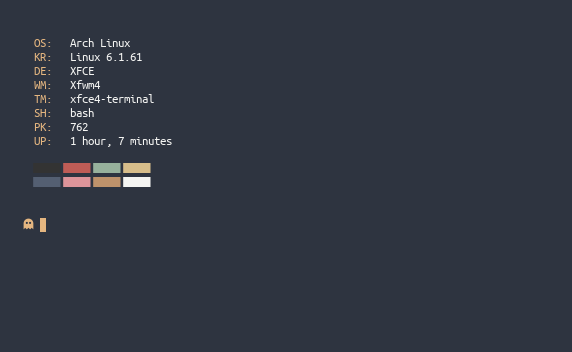
I absolutely love how minimalist this looks…
In the past, some people have expressed dissatisfaction when I’ve sent them files in .odt format. However, it’s the superior format in terms of support and functionality, so I always make them aware of that and of the fact that I will never use some shitty ms product…
xfce4-terminal has always been my go-to terminal. It may not be the lightest or the best, but it does have some neat built-in features like opening a drop-down window…
For the most part I use ncmpcpp with mpd, but sometimes whenever I just want to listen to a single file I use mpv --no-video instead…
These are the reasons why I would consider installing Nobara over Fedora…


I asked myself this exact question back in 2020 and chose Arch. At the time I had been using Fedora since 2017. What I ultimately wanted was a system I could install once and continually evolve rather than replace. Several years on, I’m still running that same installation and it has never given me a reason to reconsider…