
Mostly just used for moderation.
Main account is https://piefed.social/u/andrew_s

  • 2 Posts
  • 7 Comments
Joined 3 years ago
cake
Cake day: July 24th, 2023

help-circle
  • You can get a rough idea of how big each video is via an activitypub query for each video. For example:

    curl --header 'accept: application/activity+json' https://peertube.wtf/w/mhghLtY5dkLguNq5oFB2Ut | jq .
    

    Buried in there is a url entry, and buried in some of those is a tag entry and buried in some of those are details for the size of the video and audio for each upload.

    Peertube’s video channels have an outbox (similar to how Lemmy’s communities do, but not limited to 50 entries), so you can step through that to find the relevant info for everything in your channel.

    Doing that for your channel, I got:

    Shitpost #2
    video: 482 x 480: 2.27 MB
    audio: 0.3 MB
    
    Shitpost #1
    video: 480 x 480: 8.69 MB
    audio: 0.94 MB
    
    Will this replace the internet?
    video: 1080 x 1920: 19.26 MB
    video: 720 x 1280: 11.9 MB
    video: 360 x 640: 5.23 MB
    audio: 16.75 MB
    
    Cat
    video: 1920 x 1080: 7.77 MB
    video: 1280 x 720: 2.14 MB
    video: 640 x 360: 0.41 MB
    audio: 0.23 MB
    

    If you assume that the size of the audio is ignored, and that lower resolutions are transcoded as requested, and add the sizes for the highest resolutions together, you get 2.27 + 8.69 + 19.26 + 7.77 = 37.99 (which is the 38 MB visible in your screenshot).

    The information is available, but it’s a pain in the arse to get, so it’s probably annoying for PeerTube themselves to show (a brief look suggests that the API response doesn’t provide it, so there’s nothing for the web frontend to display). It’s also possible that they may drop the higher resolutions for videos with low engagement, so the size of each upload isn’t static, which adds an extra complication.


  • Not really.

    Gup.pe groups were genuine ActivityPub Groups, like Lemmy communities, whereas these ‘FediGroup’ things are just Mastodon bots. They’re a ‘Service’, aka the automated version of a ‘Person’, so they’re no use to anyone on platforms (like Lemmy) that can only follow Groups.

    The most similar recent thing to gup.pe is https://ovo.st/

    Compare:

    curl --header 'accept: application/activity+json' https://lemmy.world/c/fediverse | jq -r .type   
    => Group   
    curl --header 'accept: application/activity+json' https://ovo.st/club/askfedi | jq -r .type  
    => Group
    
    with
    
    curl --header 'accept: application/activity+json' https://fedigroups.social/@audiofiction | jq -r .type  
    => Service


  • Hmmm. Speaking of Fediverse interoperability, platforms other than yours (Pandacap) typically arrange things so that https://pandacap.azurewebsites.net was the domain, and something like https://pandacap.azurewebsites.net/users/lizard-socks was the user, but Pandacap wants to use https://pandacap.azurewebsites.net for both. Combined with the fact that it doesn’t seem to support /.well-known/nodeinfo means that no other platform knows what software it’s running.

    When your actor sends something out, it uses the id https://pandacap.azurewebsites.net/, but when something tries to look that up, it returns a “Person” with a subtly different id of https://pandacap.azurewebsites.net (no trailing slash). So there’s the potential to create the following:

    1. https://pandacap.azurewebsites.net/ sends something out.
    2. Instance hasn’t heard of that, so looks it up, and creates a new user in its database, with the returned ID (https://pandacap.azurewebsites.net)
    3. https://pandacap.azurewebsites.net/ sends else something out. Instance looks in it’s DB, finds nothing, so looks it up and tries to create it again. The best case is that it meets a DB uniqueness constraint, because the ID it gets back from that lookup does actually exist (so it can use that, but it was a long way around to find it). The worst case - when there’s no DB uniqueness constraint -is that a ‘new’ user is created every time.
    4. Repeat step 3 for every new thing you send.

    If every new platform treats the Fediverse as a wheel that needs to be re-invented, then the whole project is doomed.


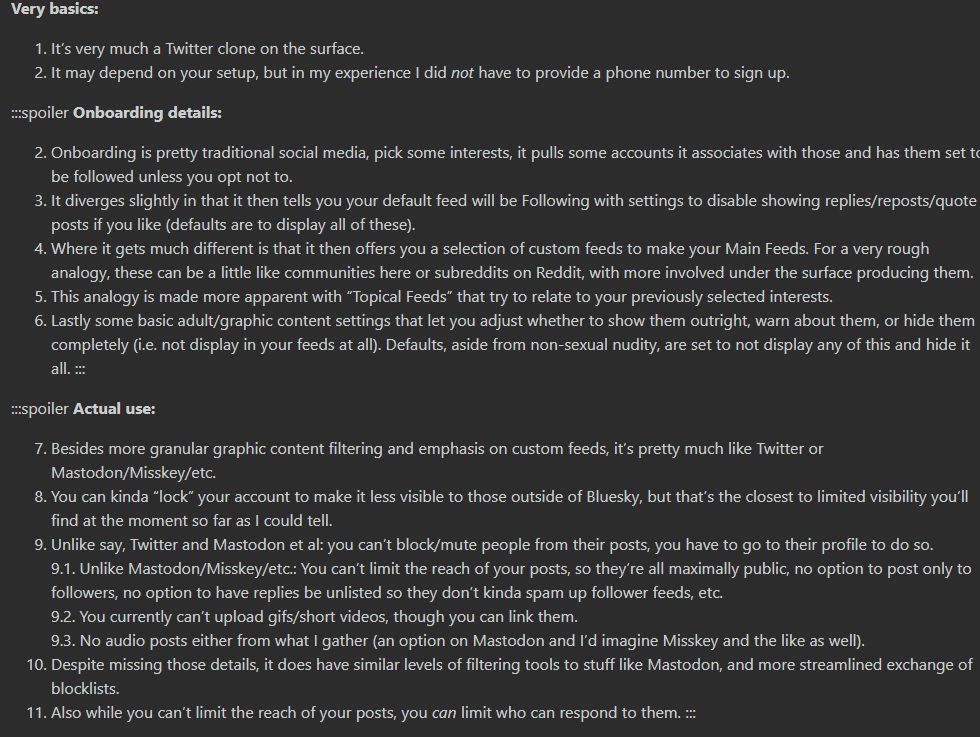
  • Firstly, sorry for any potential derailment. This is a comment about the Markdown used in your post (I wouldn’t normally mention it, but consider it fair game since this is a ‘Fediverse’ community).
    The spec for lemmy’s spoiler format is colon-colon-colon-space-spoiler. If you miss out the space, then whilst other Lemmy instances can reconstitute the Markdown to see this post as intended, Lemmy itself doesn’t generate the correct HTML when sending it out over ActivityPub. This means that other Fediverse apps that just look at the HTML (e.g. Mastodon, KBIN) can’t render it properly.
    Screenshot from kbin:

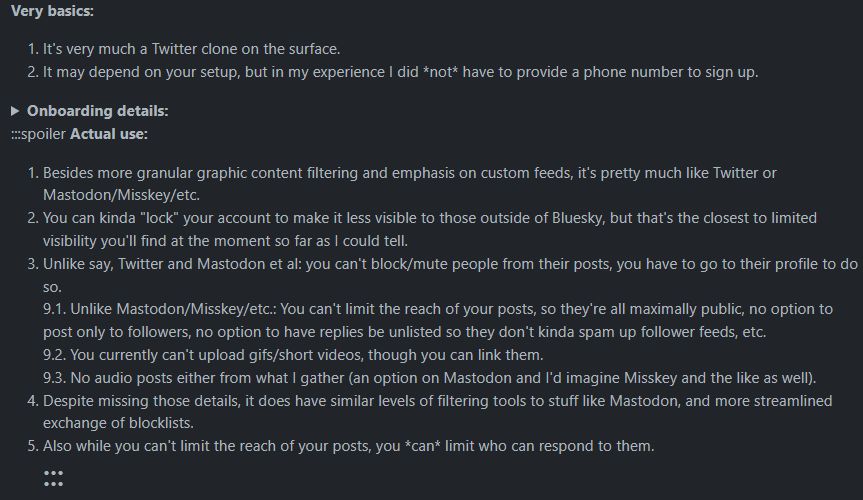
    Also, if you add a horizontal rule without a blank line above it, Markdown generally interprets this as meaning that you want the text above it to be a heading. So anything that doesn’t have the full force of Lemmy’s Markdown processor that is currently trying to re-make the HTML from Markdown now has to deal with the ending triple colons having ‘h2’ tags around it.
    Screenshot from piefed:

    (apologies again for being off-topic)


  • I know for sure that Lemmy won’t, it’s likely the same for Mastodon.

    I was wrong about not being able to WebFinger your account - I still had the @ at the beginning when I trying. Doing it properly:

    curl --header 'accept: application/json' https://mostr.pub/.well-known/webfinger?resource=acct:910af9070dfd6beee63f0d4aaac354b5da164d6bb23c9c876cdf524c7204e66d@mostr.pub | jq .
    

    gets the right response.

    However, I’m logged into lemmy.world and it still couldn’t get your account. At a guess, it’s because there’s a 20 character limit on usernames.


  • Lemmy instances won’t search outside of their own databases if you’re not logged in.

    But if you are, what it does can be recreated on a command-line by doing:
    curl --header 'accept: application/json' https://nerdica.net/.well-known/webfinger?resource=acct:nate0@nerdica.net | jq .

    This shows that your profile is at https://nerdica.net/profile/nate0. Lemmy puts all users at a /u/, but using webfinger means that other fediverse accounts don’t have to follow the same structure. For lemmy.world, you’re at https://lemmy.world/u/nate0@nerdica.net in the same way that a mastodon user is at e.g https://lemmy.world/u/MrLovenstein@mastodon.social.

    edit: However if you webfinger your mostr.pub account, you get: {"error":"Invalid host"} so any ActivityPub instances will only ever be able to find you if you’ve interacted with them in some way to get a database entry. Edit: also, I tried to do this again, thought I’d try the npub1 account as well, but got Gateway Timeouts, so there’s a bit of jankiness going on too.