

7·
1 year agoIon and plasma drives. They’re electric and work very well. All the thrust of a hefty fart, but high specific impulse allows them to burn for a long time, so they’re great for maneuvering in the vacuum.
Ion and plasma drives. They’re electric and work very well. All the thrust of a hefty fart, but high specific impulse allows them to burn for a long time, so they’re great for maneuvering in the vacuum.

I lose Virtual Desktop for my wireless VR, 3ds Max and Solidworks for CAM. If all I did was gaming, media and browsing, I’d switch. Which is why my HTPC, only used for couch gaming and media, is running Bazzite.
If Supes is doing it to stop some dickwad from destroying the Earth, enslaving humanity, or erasing the concept of pizzas, I’ll be yelling at him to do it again. Fuck the car, I can walk!

Nope. Not until they’re going for a Ship catch. It has to come down somewhere and the only places it can safely come down are either the ocean or the catch tower. So until they get the catch hardware to a state where they believe it would work out, every Ship is going to fly a trajectory that ends in the ocean.
It’s hard to tell, but I don’t think it’s from IFT-6. The banana cam gave us a view inside the payload bay and the reinforcing structures look a little different.
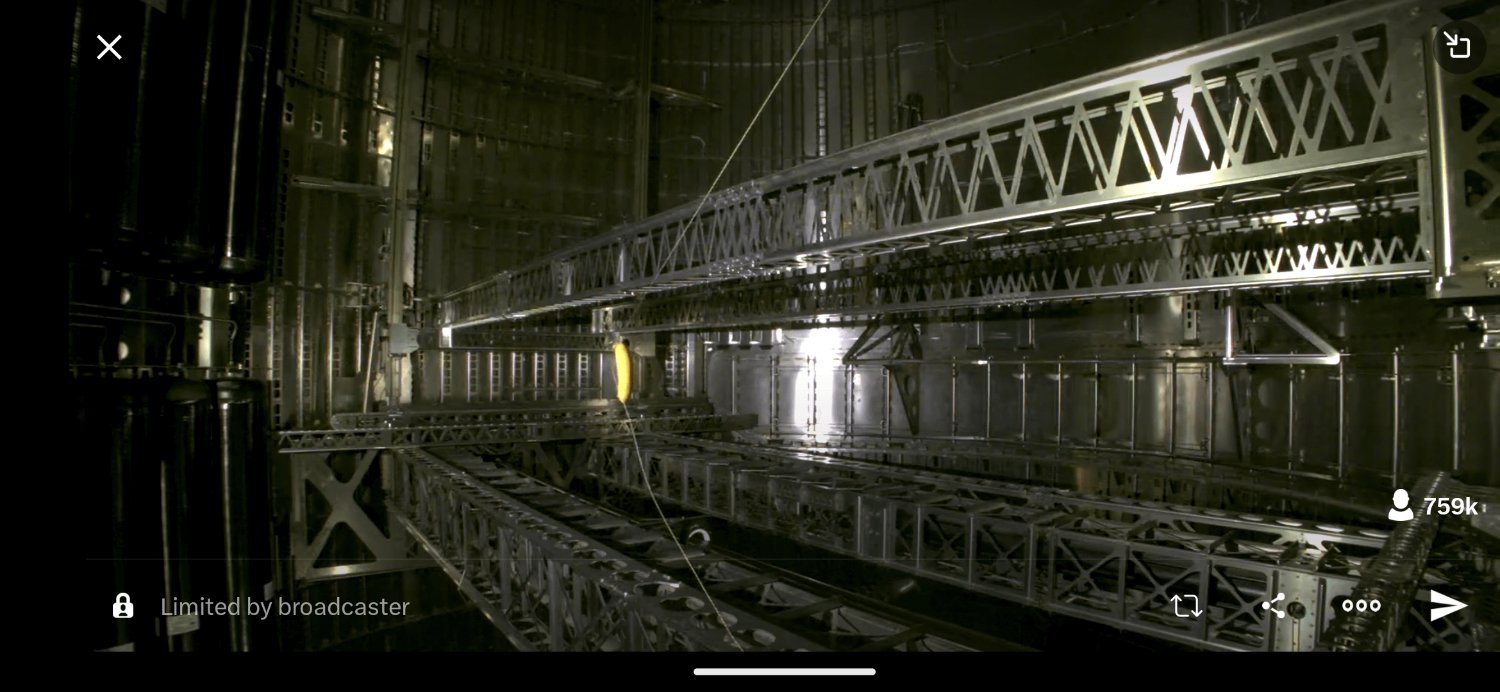
I believe the truss that the banana is strapped to is the same as the one running along the lower edge of the OP image. But if you look at the reinforcements noseward, the OP shows a closer arrangement of three ribs with cross-braces in-between, whereas the IFT-6 image shows more regularly spaced ribs with no extra bracing. The ribs themselves look different, with a uniform line along the entire inner side in the OP, and a shallower middle segment on OFT-6. The OP’s low resolution makes it difficult to tell, but I think it’s also missing a lot of the lengthwise stringers that SpaceX added on the later ships.
EDIT: I may be talking out of my ass. Had a look at IFT-3 and the view towards the payload door shows the same reinforcing structures as IFT-6. So it’s possible that the OP image is from farther up the payload bay, the ribs we’re seeing are reinforcing the flap hinges, an area that’s not visible in the banana cam. We didn’t get a payload bay view for flights 4 and 5, so can’t compare those.
EDIT 2: The OP image is definitely farther up the payload bay, looking at the hinge area that we didn’t see in other bay views. There’s no telling whether or not it’s from the 6th flight, based on the publicly available images.
Most of the Falcon 9 launches are for Starlink and are paid for by SpaceX themselves. How is that “the government subsidizing them”? If you want to argue that they’re using money they got from NASA to fund those launches, is your plumber feeding their family from you subsidizing their life?
There’s two main benefits: faster reuse and more payload to orbit.
A Falcon 9 landing on a drone ship needs to be transported back to shore. That’s multiple days before the engineers even get their hands on it to prepare for the next flight. The design goal of Starship is to launch a Ship into orbit, return to the tower, be restacked, refuelled and launched again in the same day. Will they actually get it to the point where that’s possible? Remains to be seen. Until now, they had no way to see what real stresses a Starship booster goes through in a flight. They’re gonna rip this one apart down to the spacers in its bolts to examine it. With the flight and physical inspection data, they’ll make what improvements they can to the already built boosters and design future boosters to be more resilient. SpaceX has, by now, a well proven track record of doing what others think is insane to even attempt. If anyone can launch the same rocket twice in a day, there’s no one better to give it a try.
The increased payload comes from not having the mass of the landing legs. The Falcon’s landing legs weigh several tons. Starship, being 3x the diameter and 10x the mass, would need titanic landing legs. That’s a lot of tonnage you won’t be taking to orbit. Catching on the tower means that all but a fraction of the landing hardware’s mass isn’t on the rocket itself. As an additional benefit, the landing hardware needs to be built only once. Every Falcon has its own landing legs, but every Starship they ever build could land on the one tower they have now. That won’t be the case, they’re planning to build multiple towers, but the sentiment remains the same.
NASA has the measurements of all their astronauts and Dragon flight suits for Butch and Suni are already made.

It’s stronger than aluminium, as well as easier to manufacture and work in less-than-ideal conditions than carbon fiber. Useful traits when your end goal is to build a whole fuckton of the biggest, most capable, fully reusable rockets in history.
Thunderfoot’s psychotic obsession with Musk and the complete denial of reality happening before his eyes it necessitates has destroyed any credibility as a scientist he ever had. The authority of a food chemist on matters of rocket science is questionable in the first place. Your blind, unquestioning acceptance of whatever drivel escapes his frothing mouth is no less pathetic.
And with that, I’m going to toast to the memory of the brain cells I’ve lost over the course of this “conversation”. Hoping for anything even resembling a reasoned argument from you is clearly a fool’s errand.
Yeah, you got nothing.
Fucking lol.
EDIT: Hoo boy, you didn’t even look at what you linked, did you? My point was that SpaceX has completed 8 crewed missions. The video is just half an hour of Thunderfoot’s inane rambling about launch costs. Not a single word about whether or not SpaceX has completed any crewed missions, ISS or otherwise. That’s the point I’m challenging you to disprove here. Go ahead. Show your work. I’m looking forward to it.
They have 8 incident-free crew missions under their belt. Sit your ass down, the adults are talking.
What’s your reasoning behind the claim that a company that’s been transporting crew to and from the ISS for 4 years, and currently has a vehicle docked to the station, is incapable of launching a tenth mission? Mind that said mission was supposed to launch next week, but Starliner is being a pad princess in orbit and won’t get off the required docking port.
Cause no one wants to look like the idiot. And when no one has read the article, it’s a lot harder to dispute the claims of what the article is about. It’s a vicious cycle - someone who hasn’t read the actual article makes claims about it, others who also haven’t read it react and before you know it, you’re ten posts deep, arguing about something that may or may not have happened. All it takes is one person to make an under-informed post and another to pick up on it. The difference between thousands and millions of users affects only the probability of it happening.
They’re probably still poring over the data. Telemetry from the temperature sensors, the feeds from the internal cameras, data from the booster and why two of its engines failed and so on. Most likely also data on what and how many TPS tiles S29 lost on the way down, I doubt the video feeds were their only way of checking those All in all, it’s gotta be terabytes of data to sort through and analyze
They did leave two tiles off the aft end and put in a thinner tile. Possible that those spots burned through and damaged the sensors, but the sea-level engines were healthy enough to still work.
It’s not Reddit behavior. It’s just the limited capacity we have for dealing with the flood of information we’re exposed to. Between that and the daily stresses of work, family and whatever else a given person has going on, there’s no time to filter out what is or isn’t important, there’s no time for nuance or thought, there’s only time enough for a knee-jerk reaction before the next aggravating thing comes along.
We (as in humanity) can continue to develop both EEG caps and direct implants. The technology is young and there’s no telling what side benefits and additional functionality either one can have.
And the implant, much like early EEG devices, barely works for now. Imagine what they’ll be capable of 10-20 years down the line.

But exactly because of that, they don’t have yeet. Long periods of low thrust are great for long duration missions, like satellites, stations and interplanetary probes, awful for a TLI burn.