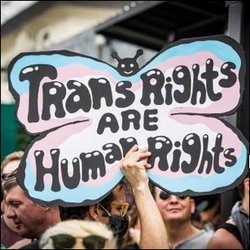

Gender-critical forces in the UK are mustering yet again and need to be opposed. Their latest anti-trans action is about the British Conversion Practices Bill.
This Conversion Practices Bill partially outlaws conversion practice for trans people and the British Government is in the call for evidence phase of that bill. Labour have already gutted it by allowing medics to do Conversion Practice, but UK gender-critical forces are trying to expand it to allow parents to do it.
I mean I’m opposed fundamentally to reducing people’s rights for no readily apparent reason simply because some pearl clutches, who it doesn’t in fact affect, are upset about it. In fact I think that if a bill is proposed that pearl clutches get upset about, I’m all the more in support for it, fuck these guys.
Why on earth do we spend any time listening to them? We don’t take advice from flat earthers on science funding, so why do we need to listen to religious nuts when it comes to trans rights? In fact there’s plenty in the church that would be opposed to this bill simply because it’s infringing on people’s freedoms, so it’s not even the entire church. This fact alone should kill the discussion. I’m so sick of these arse wipes constantly trying to re-litigate things simply because they don’t like the outcome.
Can we just ban religion from having a say in anything?
Why can’t the government just leave it alone?
Trans rights are so important to such a tiny minority and yet have such an inconsequential impact on the vast majority who are not Trans.
All this Conversion Therapy is being brought on by Religious Zealots pushing their agenda - I feel, mostly from US influence.
I can only hope that people produce a staggering amount of evidence about how detrimental it is to Trans people and ends up prohibiting Religious groups and medical staff from referring or doing any Conversion Therapy.
Religion has mastered one remarkable skill: surviving without evidence. For thousands of years, gods have been proposed, worshiped, feared, obeyed, and defended yet never independently verified. This is not a minor oversight. In every other domain of human knowledge, claims without evidence are discarded. Only in religion are they protected, revered, and shielded from scrutiny. Atheism begins with a simple, unromantic question: Where is the evidence? Not the feelings, not the traditions, not the anecdotes but the verifiable, testable, independently confirmable evidence. When that question is asked honestly, belief systems that rely on revelation and authority rather than observation begin to wobble. Faith is often praised as a virtue. In practice, it is an admission of ignorance dressed up as confidence. Faith exists precisely where evidence does not. No one has “faith” that gravity works or that germs cause disease. Those are facts established through experiment and replication. Faith only enters when knowledge fails. If faith were a reliable path to truth, different religions would converge on the same conclusions. Instead, they contradict one another on every fundamental claim how many gods exist, what they want, who they favour, and what happens after death. Billions of believers, thousands of gods, zero consensus. Why should we treat any one of them as special? A popular apologetic claim is that religion “invented” science or was its primary driver. History tells a messier story. Scientific progress emerged when thinkers began questioning authority including religious authority and insisting on evidence over scripture. Copernicus, Galileo, Darwin, and countless others faced religious resistance, not encouragement. The Catholic Church condemned heliocentrism. Protestant leaders rejected evolution. Even today, creationism and intelligent design attempt to smuggle theology into science classrooms despite overwhelming biological evidence to the contrary. Another common claim is that without God, morality collapses. This argument misunderstands both morality and human behaviour. Moral systems existed long before monotheistic religions and vary widely across cultures. Empathy, cooperation, and fairness are products of social evolution, not divine command. If morality truly came from God, believers would behave demonstrably better than nonbelievers. They do not. Study after study shows no consistent correlation between religiosity and moral behaviour, and some of the least religious countries score highest on measures of social trust, equality, and well-being. Prayer is often described as powerful, transformative, and effective until it is tested. Controlled studies consistently show that intercessory prayer has no measurable effect on recovery, illness, or outcomes. In some cases, being told you are prayed for worsens outcomes due to performance anxiety. If prayer worked the way believers claim, hospitals would replace ICUs with chapels. They do not. Why? Because when lives are on the line, even believers trust medicine, not miracles. Why is scepticism encouraged everywhere except religion? Why are children taught to question advertisements, politicians, and strangers but not gods? Why is doubt framed as intellectual honesty in science and rebellion in theology? What would happen if religious claims were held to the same standards as scientific ones? If holy books were treated like hypotheses? If miracles required evidence before belief? Would anything remain? Atheism Is Not Nihilism It Is Responsibility. Atheism offers no cosmic rewards, no eternal surveillance, no divine forgiveness loopholes. That is precisely its strength. Meaning is not handed down; it is constructed. Morality is not outsourced; it is owned. There is no god to blame, no plan to hide behind. If this life is the only one, we know we have, then cruelty is less excusable, not more. Kindness matters now. Justice matters now. Truth matters now. And that is what makes atheism unsettling not that it removes meaning, but that it removes excuses. If faith is a reliable path to truth, why does it produce contradictory conclusions? Why are religious claims exempt from the standards applied to every other claim? If morality comes from God, why do moral intuitions change over time and culture? What belief would you abandon if evidence disproved it and why should religion be different?

Are you just copying facebook posts?
No.
I support freedom of religion. However, that right should not cover pushing those views on others, and definitely does not trump their human rights, including trans rights.
I am a reasonable man and am certain that Christian holy book the Bible is an absolute heap of disgusting, slavery condoning, male infant genital mutilation demanding, repellent, demented, vicious dark age mumbo jumbo. Given the time gap between the events recorded in the gospels and the and the estimated time they were written, the fallibility of human memory, and the potential unreliability of eyewitness testimony, the Gospels are not historically reliable with regard to the resurrection of Jesus. The gospels were written decades after the events they describe. They are reliant on the memory of unknown persons, oral traditions, and possibly other written sources that are no longer available. What’s wrong with memory? Human memory is fallible, particularly over long periods of time. It’s feasible that the authors unintentionally introduced errors while describing the resurrection event. What’s the problem with oral tradition? It was a means of transmitting information in societies that were largely illiterate. Unfortunately, as stories are passed down, the retelling of the story can include slightly different details due to memory distortion and reconstruction, and the differences can become amplified as the story is retold many times. We have watched this happen in a manner of minutes of a story being told. If you’ve ever heard of the telephone game this is a great example of this phenomenon happening. Perhaps the gospels were based on prior sources. If they are, we know nothing about these prior sources. Christians should be told quite clearly that our citizens have the legal right to criticise, lampoon, ridicule and mock god and Jesus to their heart’s content, in any way that they wish: that Christians have no special claim to protection from the rough and tumble of post-Reformation and postEnlightenment intellectual, political and social life. If they cannot live in a society in which this is the case, they should go somewhere else; they are, after all, spoilt for choice, at least in theory. Iran seems to be a very enlightened state.!
Ideally I would support freedom of religion but in reality, it’s always Religion that muscles its agenda into politics and interferes with other peoples lives.
And so, I can’t support it.
Religion is an after-school club, a weekly social event in hall somewhere - for me, it does not have place in Governing a country of many Creeds, Colours and Cultures.
As a scientist, I am accustomed to the idea that truth claims ought to be justified with some reasonable evidence: if one is going to claim, for instance, that a Jewish carpenter was the son of a God, or that there is a place called heaven where some ineffable, magical part of you goes when you die, then there ought to be some credible reason to believe that. And that reason ought to be more substantial than that it says so in a big book.
Religious claims all seem to short-circuit the rational process of evidence-gathering and testing and the sad thing is that many people don’t see a problem with that and even consider it a virtue. It is why I don’t just reject religion, but actively oppose it in all its forms - because it is fundamentally a poison for the mind that undermines our critical faculties.
Religious beliefs are lazy jokes with bad punchlines. Why do you have to chop off the skin at the end of your penis? Because God says so. Why should you abstain from pork, or shrimp, or mixing meat and dairy, or your science classes? Because they might taint your relationship with God. Why do you have to revere a bit of dry biscuit? Because it magically turns into a God when a priest mutters over it. Why do I have to be good? Because if you aren’t, a God will set you on fire for all eternity.
These are ridiculous propositions. The whole business of religion is clownshoes freakin’ moonshine, hallowed by nothing but unthinking tradition, fear and superstitious behaviour and an establishment of con artists who have dedicated their lives to propping up a sense of self-importance by claiming to talk to an invisible big kahuna. It’s not just fact-free, it’s all nonsense.’


