These threads are such a shit show. No one reads the article and then just has the conversation they want to have, other people who didn’t read the article think they’re summarizing it, and everyone walks away dumber.
I read the article but it doesn’t say much that hasn’t been said a thousand times before.
Thread is a mess though I’ll agree on that.
Online discourse tends to be like that
Because why would I read an article that’s probably riddled with ads, when I could read a quick unbiased fact in the headline (edit: and an image) and get expert commentary in the comments (that often builds upon or refutes the article anyways)?
Run an ad blocker. Firefox + uBlock origin does wonders.
Reading the article is a prerequisite to not being taken by disinformation.
Sadly I’m on an iPhone, though I do have one on my desktop.
I think adblock plus works on Safari on the iPhone.
adblockers have been a thing on iPhone for years, even I know that and I don’t have one. How are you this ignorant?
Better off running a pihole, block at the network level.
Positive feedback loops, how do they work?
We’ve known about this for decades. An example: heating causes permafrost to melt releasing CO2 and methane, which cause more heat to be trapped, which melts more permafrost, which releases more green house gasses, etc.
Positive feedback loops tend to be very unstable, and can lead to runaway situations.
Can’t wait for all those ice caps to go away and stop reflecting all the heat that they do reflect being white. It’ll just add to it.
And when the last ice is gone we will finally have revenge for the Titanic
Hey I found time to laugh in between my doomsday crying.
Thanks. :)
Not if blackhat has anything to say about it: https://xkcd.com/2829/
Worse, when that influx of arctic water shuts down the North Atlantic current and others that cycle heat and cold throughout the world. That will be very bad for quite a lot of us.
deleted by creator
Looks like it might be a good idea to paint sections of buildings black and white, colour coded for heating lol
We actually paint the top of some helicopters to make the ride cooler for everyone inside.
Can’t wait until we turn the planet into Venus 2.0
Ive read somewhere that living in the clouds is in theory still possible. :)
I’d like to live on the ground with the grass and the trees, thanks
Sorry, best I can do is underground bunker

“go touch grass” will be the new “kill yourself” in a century 😂
The article goes out of its way to claim this isn’t the case. Theres a line that says something like there is no extra heat in the pipeline.
I followed the links in that quote:
Climate models have consistently found that once we get emissions down to net zero, the world will largely stop warming; there is no warming that is inevitable or in the pipeline after that point.
Neither addresses tipping points. They seem to talk about something else entirely, like wether a model assumes constant atmospheric concentration, or constant emissions, that kind of difference.
Ah, i see what you are saying now, sorry
deleted by creator
There’s so much wrong with comments starting with “So you …”.
Yes, I’m not a climate scientist. I don’t have the time and energy to read all the relevant papers, nor do I need to do so to participate in the discussion on Lemmy. Sometimes I do, but I’m not obliged to, and you’re not in a position to judge.
It’s great though that you read the paper. Can you support your claim with quotes from it? After all, I don’t trust random dudes.
deleted by creator
Nah, that’s you. Oh, ok. I did not understand you wanted to point out that. This is confusing. Maybe you misunderstood my initial comment.
I’m not agreeing with the quote from the article, but speaking against it.
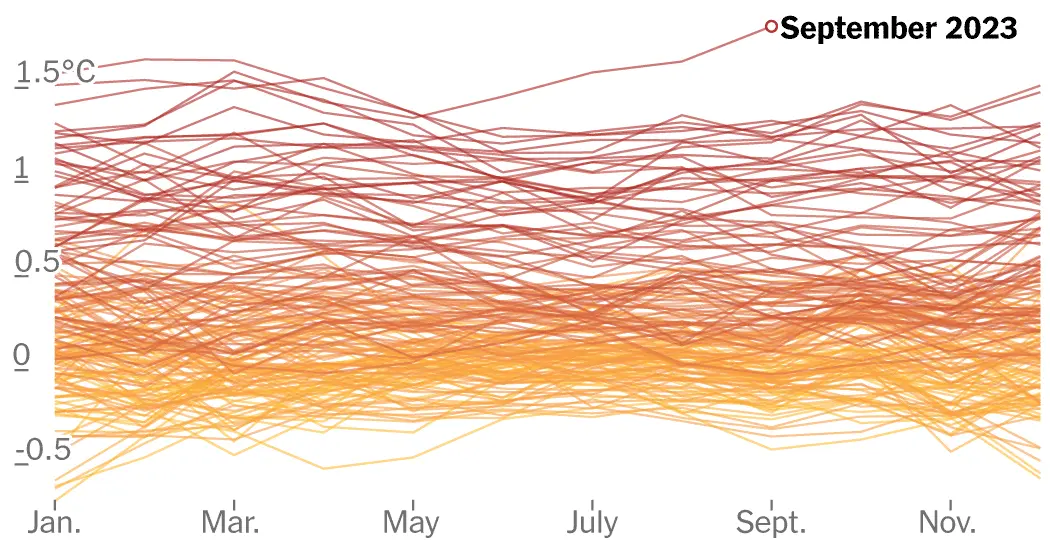
Beginning to think we’re going to hit 1.6c next year, not 2050.
As much as this news disturbs me … the thing that disturbs me most is that most of the world will ignore it.
Humanity won’t do anything about any of this until millions die and mass migrations start happening due to extreme weather events.
COVID was the perfect microcosm for climate change action. COVID killed a shit-pile of people really quickly. Humans are wired to acknowledge pressing matters (like a pandemic), while more abstract concepts, and things with delayed consequences get pushed to the wayside.
It make sense, why we are the way we are. Who cares about where your meal next week is going to come from, when you’re a caveman running from a lion?
Does it make us any less dead? nope. Just the timing is in question.
Even covid was already too hypothetical and abstract and too far away in time and space for millions of people to act cautiously. Climate change is further away still… When it becomes very noticeable, it’s far too late: hawaii fire level stuff before people actually realise it’s fucked.
Hawaii fire level stuff is due to climate change.
Yes. I meant many people only realise it when they are the one stuck there and can’t get out.
the number of chuds I’ve met that really, really think it was some kind of space laser and not a wildfire driven by hurricane winds and crippling heat is fucking depressing. people I volunteer with who I thought were rational humans… what in the fuck
Fun fact! Mines take climate change into consideration for all their engineering and revgetation designs
#TheEarthHasAlwaysHadClimateChange
#butNeverThisFast #itsAlsoNeverBeenThisHotSinceHumanityAppearedOnEarth
I think I should have added ‘/s’.
I’m no denier.
Correct, there has always been climate change … most of the change in the past happened over a millennia … and some of it was catastrophic with changes happening over short periods of time and it usually meant the death of millions of life forms
The current climate change period we are living in is human made most definitely … if our descendents survive, (or whatever new species takes over … or even if artificial intelligence takes over) tens of thousands or millions of years from now - when they look back at the geologic record, they’ll wonder why there was a weird global distribution of radiation and toxic material everywhere and they will notice the fact that a large percentage of species everywhere died off at around the same time we started to develop into the technological / communications age
Climate change has happened in the past … what most people that say this leave out is the fact that it tends to kill off many creatures that can’t adjust to the changes … and if the changes are dramatic enough, it tends to cause a mass die off of creatures on the planet … and what many of these proponents tend to conveniently leave out is that WE may be one of those species that will die out because we won’t be able to survive these changes. We’re technologically smart and we are creative … but this isn’t Hollywood, we won’t pull off a last minute super hero, Hail Mary, super smart group of people get to save the day at the last possible moment … if things fall apart, it will happen slowly over decades until we all fall apart, society fails and we all just slowly fade away because there is nothing liveable left to save ourselves.
It’s already basically too late and once millions die it will be super mega too late no take backsies.
Humanity won’t do anything about any of this until millions die and mass migrations start happening due to extreme weather events.
We won’t do anything even then.
Well, not anything that’d help, at any rate. The worse things get, the more people will vote for conservatives and populists who will sell them easy solutions, which will likely consist of mass violence and rolling back environmental regulations because they inconvenience their voters. The only thing that will actually help will be the inevitable collapse of industrial society at this scale, but to get there hundreds of millions if not billions will die pointless deaths, especially if nuclear weapons are involved in the collapse.
At this point I want collapse to hurry up so that the old fuck boomers have to deal with it.
deleted by creator
We’ve discovered the breaking point of paradise. Hope the next sentient species is a little less selfish.
Unfortunately, I don’t know if it would be possible for another species to reach our level of technology or civilization. We built up our society off of easily accessible energy resources (surface-level coal being our first source of industrial energy). This energy excess allowed us to develop other sources of energy, solar, wind, nuclear, etc. But if you tried starting from zero again, you could never get to this point, at least along the same path, as you need a high level of technology to access any available energy resources. Thus, if any new species took our place, they could only ever rise to the level of the pre-industrial revolution.
Perhaps if it’s a few million years later and all us dead humans have turned into coal and oil, like the dinosaurs of the past.
Im quite confident that this takes a few hundred million years until we talk about usable quantities.
At the very least, even basic electricity production requires copper windings. Which requires copper wire. Which requires refined copper. Which requires copper ore. Which requires copper mining.
Generations of people with manual tools will need to die in the mines for enough electricity to be generated to run a small medical clinic, let alone get post-climate humans to a point of modern civilization.
While it’s definitely bleak, it’s not quite as bleak as that. Remember that we’re leaving behind vast amounts of ‘waste’, much of which contains things like copper, aluminium, steel and other useful components in relatively easily refinable states.
Future civilisations will be digging through our waste, wondering why we were so profligate, but glad to have it all to hand.
I had thought about this scenario before too, but now I can think of many other scenarios where this doesn’t happen.
Examples: a complete loss of most of humanity’s technological know-how to where we don’t even know how or why use those materials, loss of knowledge of where many of these (mostly difficult to harvest?) resources are buried, and warring between factions for access to these resources. Not only each of those scenarios individually, but also a combination of all of them plus other factors working against this happening.
I think that the eventual best case scenario for humanity will be going back to pre-industrial living and technology.
Those are fair points, but consider that they just put the next civilization at the same level we were; we didn’t have the technological know-how until we invented it, we didn’t know how or why to use different ores until we worked it out, we didn’t know where the ores were to be found until we gound them, and harvesting pre-refined material is much less intensive than that, and well, we’ve warred, and continued to war over access to resources.
Basically, we’ve dug up lots of the easily accessible ore, which has a low density (you need to dig up maybe 4 tonnes of rock to get a tonne of iron ore, and that is only between 50-75% iron, for instance) and buried it more shallowly, and at higher density. There’s still work to do to extract it, but it’s manageable with fairly low tech.
Energy sources are a little more complex, but we’ve bound up a lot of hydrocarbons in plastic and the like, which should be usable, if not ideal in their raw form.
Those are good points too, that I hadn’t thought about. I thought it would be challenging, but maybe it wouldn’t be as challenging as I had imagined it.
But who knows, maybe we would be better off going back to pre-industrial times anyway?
But who knows, maybe we would be better off going back to pre-industrial times anyway?
But how would I find interesting conversations on Lemmy if my highest tech gadget was a loom?!? :)
It’s really actually kind of fascinating when you think of how that energy source was made, with a mass die off of carbiniferous (I think) rootless trees, aka scale trees that all fell due to not being able to support their own weight probably because the incredible amount of oxygen in the atmosphere at the time, then the carbon from those trees got buried and pressed into “fuel diamonds”, plentiful and packed with all the energy a type 0 civilization would ever need, but the very fact that using the results of that die off to power our species unabashedly, has doomed us, because we finally reached that ever important ceiling that ecologists/biologists are always talking about. We thought we outsmarted evolution and nature, but we are just as much a part of it as any other being or object.
It’s kind of beautiful to me.
That’s a good thing, right? The vast majority of the results of technology and “civilization” has turned out to be nothing but a curse on this planet.
To an extent, but we have the chance of transitioning into a solar and wind society and remediate that damage. Subsequent species would not have that potential.
I wasn’t even talking about subsequent species, but our own species in the future. As for solar and wind, I’m afraid that the way that population growth and energy consumption growth interacts with the material requirements for solar and wind, that is also going to hit a wall in the not too distant future.
What paradise? Us in the developed world, that are fortunate to have our basic needs met by mostly luck of the draw, are in a bubble. It’s never been paradise, but now it’s going to be utter hell.
Heating is accelerating. IF we stop adding greenhouse gases to the air, the heating should stop. It won’t go back down without removing massive amounts of CO2, though.
IF we stop adding greenhouse gases to the air, the heating should stop.
Unless we crossed a tipping point. If so, the heating could continue although we stopped.
deleted by creator
It won’t stop unless we also remove the greenhouse gases that we put there
Unless I misunderstood, the article claims otherwise.
Yes, net zero, which some companies and countries pledged to reach until 2050. Unfortunately it’s delusional, because they count on technological fixes being invented in the future and until then it’s “business as usual”.
Industries like cement, chemical and steel will never be net zero without carbon capture for example.
The atmosphere stores negligible heat (only weather, not climate), but the ocean has a much greater capacity than the atmosphere, for both heat and CO2 (mainly in the form of HCO3-), and it takes a long time (centuries - millenia) to fully mix the ocean. Also it takes ages for icecaps to melt. If you really stop adding CO2, concentration in the atmosphere will go down slowly as it mixes into deeper ocean, but not back to preindustrial, the surface temperature will likewise go down slowly and partially after a slight lag, but ice will keep melting (-> sea-level rises) for a while. Other gases and aerosols make short term response more complex.
There’s no rule of thumb that summarises it, but I made an interactive model - here.